


AI is writing your software faster than ever. Is your organization keeping pace with the security risks?
The AI Coding Revolution Has Already Arrived
Artificial Intelligence is transforming software development at an unprecedented pace. Developers can now describe functionality in plain language and receive working code in seconds. This trend—commonly referred to as Vibe Coding—is reshaping how applications are designed, developed, tested, and maintained.
For organizations, the benefits are real and substantial. AI-assisted software development accelerates time-to-market, improves individual productivity, and eliminates hours of repetitive coding work. The term itself was coined in early 2025 and quickly caught fire: Stack Overflow’s 2025 Developer Survey explicitly cited vibe coding as an emerging trend driven by less-experienced developers using AI as a creative accelerant.
However, the rapid adoption of AI-generated code also introduces cybersecurity, compliance, governance, and software supply chain risks that organizations cannot afford to ignore. The challenge for security and technology leaders is not whether AI-generated code will be used—it already is, at scale. The challenge lies in ensuring it is used safely.
The Rise of Vibe Coding
Vibe Coding refers to the practice of using generative AI tools to create software through natural-language prompts rather than by manually writing every line of code. Developers increasingly use AI assistants to generate APIs, user interfaces, test scripts, database queries, documentation, and core application logic.
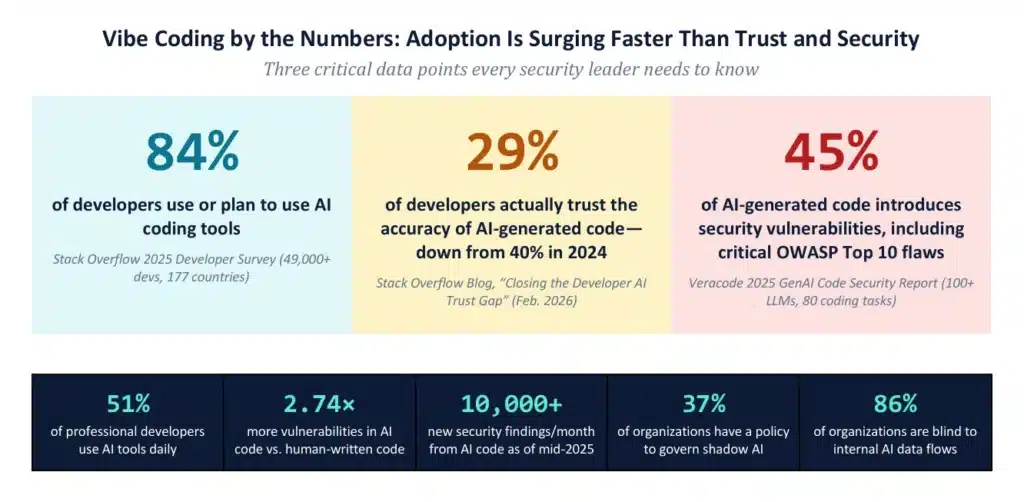
Adoption numbers tell a striking story. According to the Stack Overflow 2025 Developer Survey, 84% use or plan to use AI tools, up from 76% just one year earlier. Among professional developers specifically, 51% use AI tools daily. The JetBrains State of Developer Ecosystem 2025, drawing on 24,534 respondents across 194 countries, reported an almost identical figure of 85%.
AI-generated code is moving fast from experimentation into the mainstream development pipeline. GitHub Copilot alone reached 20 million cumulative users by mid-2025, and more than 90% of Fortune 100 companies now pay for AI coding tools. This is no longer a developer side project—it has become a part of enterprise infrastructure.
Vibe Coding is not a passing trend. AI-assisted software development is reshaping how software is built—and the security implications demand organizational attention now.
Why Organizations Are Embracing Vibe Coding
The business case is compelling. AI coding assistants help developers focus on architecture, innovation, and business value while reducing time spent on boilerplate and repetitive implementation tasks. Deloitte projects 30–35% productivity gains across the software development process, and Morgan Stanley’s internal AI tool reportedly saved developers 280,000 hours in its first months of deployment.
AI also serves as a democratizing force. Less-experienced developers can use AI assistants as real-time learning tools, reducing onboarding time and enabling faster contribution. The technology compresses the distance between an idea and working software, which is a decisive competitive advantage in fast-moving markets.
That said, speed alone cannot be the only measure of success. The productivity gains are real, but so are the risks that come with them.
Vibe Coding and the Shadow AI Problem
Shadow AI occurs when employees use AI technologies without organizational approval, governance, or oversight. Vibe Coding can become Shadow AI when developers use unauthorized coding assistants, upload proprietary source code to public AI platforms, expose sensitive data in prompts, or bypass established security controls.
The scale of the problem is significant. Research from UpGuard’s 2025 State of Shadow AI Report found that 81% of employees and 88% of security leaders admit to using unapproved AI tools. A separate 2025 report found the average enterprise hosts 1,200 unauthorized AI applications—and 86% of organizations remain blind to their internal AI data flows.
|
⚠ GOVERNANCE GAP Only 37% of organizations have policies to manage or detect shadow AI (IBM 2025 Cost of Data Breach Report), leaving the majority operating without guardrails as generative AI security risks compound. Gartner predicts that by 2030, more than 40% of enterprises will experience security or compliance incidents linked to unauthorized AI use. |
When developers use unauthorized coding assistants, they may unknowingly push proprietary intellectual property, customer data, or internal architecture details into third-party AI models. Many organizations now view AI-assisted development as one of the fastest-growing categories of Shadow AI risk—and the attack surface is expanding every week.
The Security and Compliance Risks of AI-Generated Code
The security picture painted by research is sobering. Veracode’s 2025 GenAI Code Security Report, which tested over 100 large language models across 80 curated coding tasks, found that 45% of AI-generated code introduces security vulnerabilities, including critical OWASP Top 10 flaws. Java-generated code showed the highest failure rate at over 70%; Python, C#, and JavaScript ranged from 38% to 45%.
Independent enterprise-level research reinforces this finding. Analysis by Apiiro across Fortune 50 enterprises found that AI-generated code contains 2.74× more vulnerabilities than human-written code, including 322% more privilege escalation paths and 153% more design flaws. By June 2025, AI-generated code was contributing more than 10,000 new security findings per month, a 10× increase from December 2024.
AI-generated code may also contain insecure authentication mechanisms, outdated libraries, hardcoded credentials, licensing conflicts, and regulatory compliance gaps. The danger is compounded by a false sense of security: because generated code often appears polished and syntactically functional, developers may incorrectly assume it has also been written with security in mind.
AI-generated code demands the same scrutiny we apply to any human-written software — and in some respects, even more. Working code and secure code are not the same thing.
Why CISOs Are Paying Attention
Security leaders are increasingly focused on AI-generated code for a fundamental reason: productivity gains can unintentionally accelerate the introduction of vulnerabilities into production systems. Without governance and oversight, organizations may accumulate technical and security debt faster than ever before.
The trust paradox makes this particularly acute. Zero percent of engineering leaders describe themselves as “very confident” that AI-generated code will behave correctly when deployed, according to Stack Overflow research. And the same Stack Overflow data that shows 84% adoption shows only 29% trust, an 11-point decline in a single year. And yet, 93% of enterprises now integrate AI-generated code into production systems (SQ Magazine, 2026). That gap between trust and verification is where vulnerabilities live.
These statistics are remarkable—and they signal the need for governance frameworks that match the pace of adoption.
Best Practices for Secure Vibe Coding
- Establish formal AI development policies — Define what AI tools are approved, under what conditions, and with what data restrictions, before developers need to make that judgment themselves.
- Define and enforce approved AI coding assistants — Maintain an approved-tools list and actively detect shadow AI usage across the developer environment and VPN traffic.
- Implement mandatory secure code review for AI output — AI-generated code should not bypass peer review. Establish review checklists specific to the vulnerabilities AI tools commonly introduce.
- Run SAST, DAST, SCA, and vulnerability scanning — Static analysis, dynamic testing, software composition analysis, and dependency scanning should be non-negotiable gates in the CI/CD pipeline.
- Train developers on AI governance and prompt security — Developers need to understand what data should never enter a prompt and how prompt injection attacks can be used to compromise AI-assisted workflows.
- Require OWASP Top 10 secure coding education — AI tools consistently fail on OWASP Top 10 vulnerabilities. Developers must be equipped to recognize and remediate these flaws when they appear in generated code.
- Maintain human accountability for all production code — AI generates; humans are accountable. Every line that ships to production must have a named owner responsible for its security and correctness.
- Address software supply chain integrity — AI-generated code frequently relies on third-party libraries without validating their currency or security posture. SCA tools and SBOM policies are essential.
The OWASP Connection
Organizations should strongly consider integrating OWASP Top 10 secure coding education into every AI-assisted development program. Veracode’s research specifically found that AI-generated code fails on OWASP Top 10 categories at a 45% rate—meaning nearly half of all AI coding tasks introduce one or more of the industry’s most well-documented and preventable vulnerability classes.
Developers must be able to identify, understand, and remediate these flaws when they appear in AI-generated code:
|
A01 Broken Access Control |
A02 Cryptographic Failures |
|
A03 Injection (SQL, XSS, etc.) |
A04 Insecure Design |
|
A05 Security Misconfiguration |
A06 Vulnerable & Outdated Components |
|
A07 Identification & Auth Failures |
A08 Software & Data Integrity Failures |
|
A09 Security Logging & Monitoring Failures |
A10 Server-Side Request Forgery (SSRF) |
It is worth noting that the OWASP Top 10 for LLM Applications is a separate, companion framework that addresses AI-specific attack surfaces, including Prompt Injection, Insecure Output Handling, and Supply Chain vulnerabilities introduced by the AI tools themselves. Organizations leveraging AI coding assistants should be aware of both frameworks.
How Global Learning Systems (GLS) Can Help
Combining innovation with governance requires more than technology: it requires a workforce that understands the risks and has the skills to manage them. Global Learning Systems helps organizations develop secure AI adoption strategies through comprehensive, role-based learning programs.
GLS training programs address the full spectrum of AI-related security and governance needs, including:
- Cybersecurity Awareness Training — Builds organization-wide security culture and reduces human risk factors CyberEssentials: Principles of Cybersecurity – Global Learning Systems
- Secure Coding OWASP Top 10 Education — Comprehensive coverage of the latest OWASP guidelines for Web Application . as well as developer training aligned to real-world vulnerabilities found in AI-generated code
- AI Governance Programs — Policies, frameworks, and training for responsible enterprise AI adoption
- Shadow AI Awareness — Helps employees and managers recognize and respond to unauthorized AI use
- Compliance-Focused Workforce Development — Aligns development practices with regulatory requirements and industry standards
Organizations that invest in developer security education alongside AI adoption will be best positioned to capture the productivity benefits of Vibe Coding while protecting their data, applications, and customers.
Final Thoughts
Vibe Coding is not a passing trend. The data is unambiguous: AI-assisted software development is already mainstream, and its footprint will only grow. By 2026, more than 80% of enterprises are expected to deploy generative AI-enabled applications, and AI tools are already writing a significant share of enterprise code.
The opportunity is real—so is the risk. The 55-percentage-point gap between AI adoption (84%) and developer trust (29%) is not a signal that AI tools are failing; it is a signal that organizations have work to do in governance, training, and secure development practices.
The organizations that will win are those that approach Vibe Coding with both enthusiasm and discipline—embracing the productivity revolution while ensuring that every line of AI-generated code meets the same security standard as the best human-written code in their codebase.
Ready to Secure Your AI Development Pipeline?
Global Learning Systems provides award-winning cybersecurity awareness training, secure coding education, OWASP programs, and AI governance solutions that help organizations reduce risk and strengthen security culture. Contact GLS to learn more.
References & Sources
[1] Stack Overflow 2025 Developer Survey — AI Section. “84% of respondents are using or planning to use AI tools in their development process.” 49,000+ developers surveyed across 177 countries.
[2] Stack Overflow Blog — “Closing the Developer AI Trust Gap” (Feb. 2026). “Only 29% of 2025 respondents said they trust AI, down 11 percentage points from 2024.” https://stackoverflow.blog/2026/02/18/closing-the-developer-ai-trust-gap/
[3] Veracode — “AI-Generated Code Security Risks” (2025). “45% of AI-generated code contains security flaws.” Based on testing 100+ LLMs across 80 coding tasks. https://www.veracode.com/blog/ai-generated-code-security-risks/
[4] Stack Overflow 2025 Developer Survey Press Release. “For the third year in a row…84% saying they use or plan to use AI tools.” Also notes vibe coding as an emerging trend. https://stackoverflow.co/company/press/archive/stack-overflow-2025-developer-survey/
[5] JetBrains State of Developer Ecosystem 2025. “85% of developers regularly use AI tools for coding and development.” Based on 24,534 developers across 194 countries. https://blog.jetbrains.com/research/2025/10/state-of-developer-ecosystem-2025/
[6] Modall — “AI in Software Development: 25+ Trends & Statistics” (2026). Synthesizes Stack Overflow, JetBrains, GitHub, and enterprise data. Includes 90% Fortune 100 Copilot adoption. https://modall.ca/blog/ai-in-software-development-trends-statistics
[7] SoftwareSeni — “AI-Generated Code Security Risks: Why Vulnerabilities Increase 2.74×” (2026). Details Veracode and Apiiro findings: 2.74× vulnerability density, 10,000+ monthly security findings by June 2025. https://www.softwareseni.com/ai-generated-code-security-risks-why-vulnerabilities-increase-2-74x-and-how-to-prevent-them/
[8] UpGuard — “The State of Shadow AI” (2025). “81% of employees and 88% of security leaders report using unapproved AI tools.” https://www.upguard.com/resources/the-state-of-shadow-ai
[9] IBM 2025 Cost of Data Breach Report — via ISACA. Only 37% of organizations have policies to manage or detect shadow AI. AI-associated breaches cost over $650,000 per incident. https://www.isaca.org/resources/news-and-trends/industry-news/2025/the-rise-of-shadow-ai-auditing-unauthorized-ai-tools-in-the-enterprise
[10] Olakai — “Shadow AI: The Enterprise Risk You Cannot Afford to Ignore” (2026). “86% of organizations are blind to AI data flows.” Average enterprise hosts 1,200 unauthorized AI applications. https://olakai.ai/blog/shadow-ai-risk/
[11] SQ Magazine — “AI Coding Security Vulnerability Statistics 2026”. “58% of developers trusting AI outputs without testing.” Aggregates enterprise research including Apiiro. https://sqmagazine.co.uk/ai-coding-security-vulnerability-statistics/
[12] OWASP Top 10 Web Application Security Risks. Industry-standard reference for the most critical web application security risks. https://owasp.org/www-project-top-ten/
[13] OWASP Top 10 for LLM Applications. Companion framework addressing AI-specific attack surfaces and risks. https://owasp.org/www-project-top-10-for-large-language-model-applications/
[14] CSA Lab — “Vibe Coding Security Crisis: Credential Sprawl and SDLC Debt” (2026). Details CVEs linked to AI-generated code and enterprise security findings data. https://labs.cloudsecurityalliance.org/research/csa-research-note-ai-generated-code-security-vibe-coding-202/